Know your team's real capacity.
Before it becomes a problem.
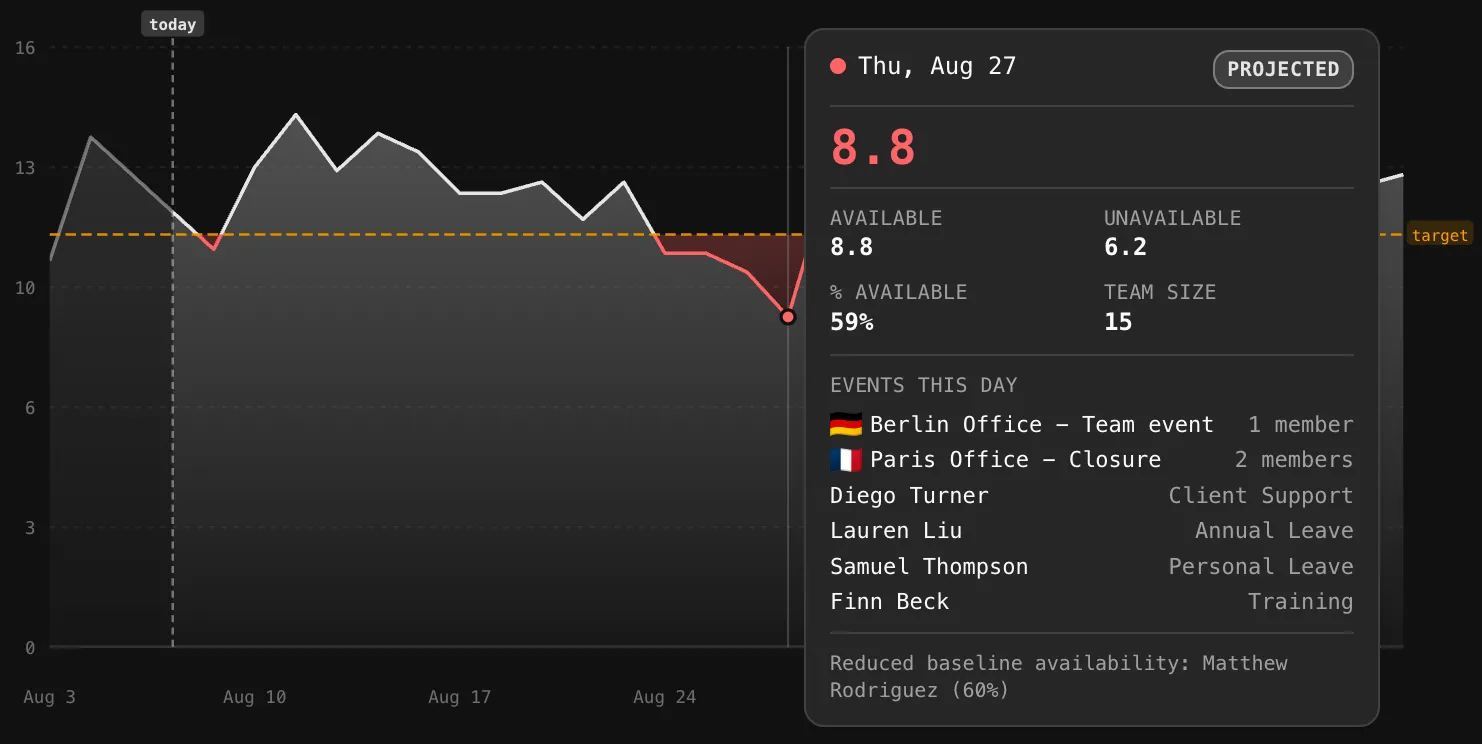
Temprix records each person's availability as a fraction rather than a yes or no, and sums it into a coverage number for every day ahead. A team of fifteen might have 8.8 people available on the 27th.
A person is not always in or out.
Your team is rarely as large as its headcount. Temprix records how much of each person is available on each day and adds it up, so you have one number for every day ahead. Switch things off below and watch the next two weeks change.
Headcount and coverage
are not the same number.
Headcount overstates what you have
Two people are in training, one is onboarding, one is half on an internal project, one is on call. The roster says twelve. The queue sees fewer.
Overlaps are hard to see coming
Approved leave, a training week and public holidays in three countries can land in the same fortnight without anyone noticing until it arrives.
Requests are answered without the numbers
Leave is usually approved before anyone can see its effect on a specific week. The consequence surfaces later, in response times and unplanned cover.
How much of each person you have, on each day.
One timeline for everything that moves the number.
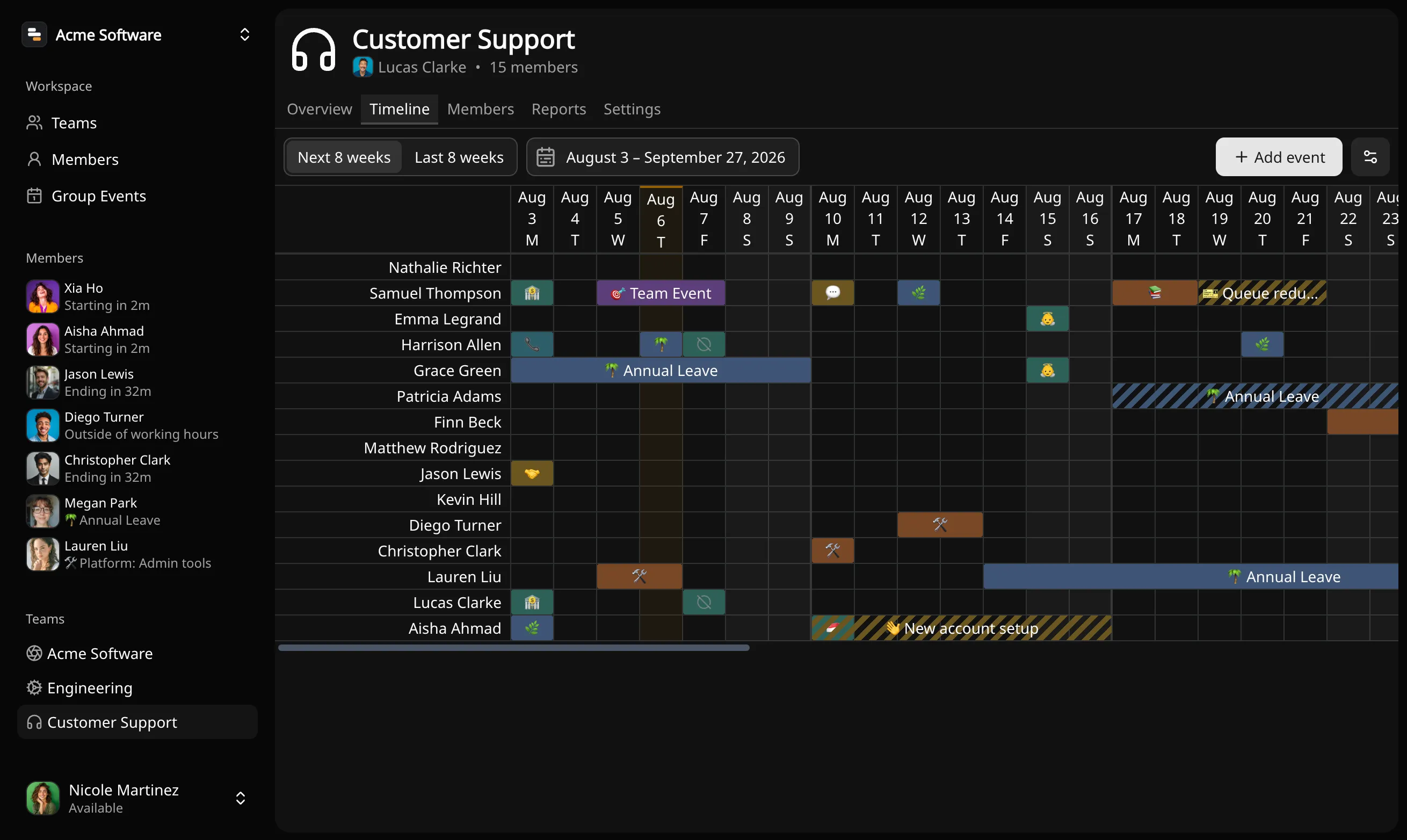
Leave, training, onboarding, on-call, public holidays — every event that shapes availability lives on a single shared timeline. Structured event types keep entries comparable across teams.
- Event categories and types carrying a default availability, adjustable per team
- Baselines for people who are permanently partial — no recurring event to maintain
- Recurring events for standing commitments
- Group events targeted by country, region or city
- Tentative events for plans that aren't confirmed
~16/10 · treatment: flat
The team total, for every day ahead — and what happens when it drops.
Coverage is a number you can plan against.
The daily totals plot forward as a curve. Set a target for the team and the gap can be read directly from the chart — in people, as a percentage, or as the difference against target.
- Forward outlook over one, two, three or six months, by day, week or month
- Target coverage as a reference line, with six display modes
- Summary of dips, days at risk, lowest day and trend
- Per-day detail showing the events behind the number
~16/10 · treatment: flat
Alerts watch the number for you.
The outlook is only useful on the days someone opens it. Set a threshold, a window and a schedule, and Temprix evaluates coverage on its own, emailing you when a new dip appears, when one deepens, and when it clears.
- Per-team rules, evaluated on your schedule and in your time zone
- A rolling window, or a fixed span for a specific period
- Emails list the affected dates and the lowest day
- Every evaluation and delivery kept as history
Customer Support drops below 6.0 in the next 4 weeks
3 new days at risk · rule “morning check”
illustrative — not a live send
The same event data, looked at backwards.
The record behind the number.
Coverage looks forward. Reports cover the same events in retrospect — how the time was distributed, how it differed per person, and what changed in the workspace.
- Time Distribution across event categories and types
- Member Time Breakdown for any period
- Member Events — the rows behind every aggregate
- Activity, over the workspace audit log
- CSV export from every tabular view
~16/10 · treatment: flat
Neither a leave tracker
nor a resource planner.
Leave trackers
"Is Sara off on Thursday?"
Absence is recorded as a flag: present or away. Training, on-call, onboarding and part-allocation have no numeric value, so they cannot be summed.
How Temprix models it
Each person contributes a value between 0 and 1. The daily total is a decimal, and it exists for every day in the window.
Resource planners
"Who is staffed on which project?"
Capacity is a budget that assignments draw down. The model assumes projects. Support and operations teams work to queues, rotations and coverage requirements instead.
How Temprix models it
Nothing is assigned. Availability begins at a baseline and events reduce it. Coverage is what remains, summed across the team, each day.
See a full month of coverage before you enter a single event.
Every account includes a populated demo workspace: teams, a year of events, working reports and alert history. The reports have data in them from the first minute. No sales call, no import, no setup.
~4/3 · treatment: flat
Your team's data, governed properly.
Availability data is personal data. Temprix is a Dutch company running on EU infrastructure. You choose the data region when the workspace is created, and it is fixed from that point on.
Read the security overview →EU data residency
Pick your workspace region at creation. Personal data stays there.
Audit log
Every change recorded — who, what, when — with an Activity report over it.
Roles
Workspace admins and standard members; team admins on Business.
Integrations
GraphQL API with scoped keys, CSV from every table. Webhooks on the way.
I built Temprix because I've been the manager reading a spreadsheet that said everything was fine, the week before half the team was out. The information was already there. It was just scattered across a calendar, an inbox and someone's memory, and nobody had added it up.
So Temprix adds it up. It's small, it's focused on one number, and it's built in the Netherlands with European data rules as the foundation rather than a later retrofit. If it saves you one bad week, it's done its job.
See what the next two months look like.
Free for teams up to 10 people, with your whole team included. No credit card.